
LOOKING AT THE ECONOMY FROM THE SKY!!!
Divine Economics is the study of economics and religion in each other’s context. The framework was first presented in 1999 as a Doctoral Research work at School of Economics Quaid-i-Azam University Islamabad Pakistan and later expanded during 2 successful fellowships at Harvard University USA and London School of Economics UK in 2006-08
Our Projects
Three HEC Assisted Research Projects
Divine Economics Project 2013
The Role of Values, Social Capital, and Spiritual Capital in Normal and Post-disaster Economic Behaviours: An Empirical Extension of Divine Economics Framework in Sustainability Perspective
Divine Economics Project 2017
Values & Wellbeing in Pakistan- Carried out at Kashmir Institute of Economics University of Azad Kashmir. A national level Divine Economics Survey 2017 (on Wellbeing, Ethical Values, Morality, Religiosity, Social Capital, Time allocation etc. along with MPhil/PhD specific extended modules) was carried out in Pakistan. Parallelly an online Universal Values Survey was also conducted.
Divine Economics Project 2018
Multidimensional Divine Wellbeing in Pakistan- Jointly carried out by Kashmir Institute of Economics University of Azad Kashmir with School of Economics, Quaid-i-Azam University Islamabad Pakistan. The project was funded by Higher Education Commission Pakistan Thematic Research Grant Program
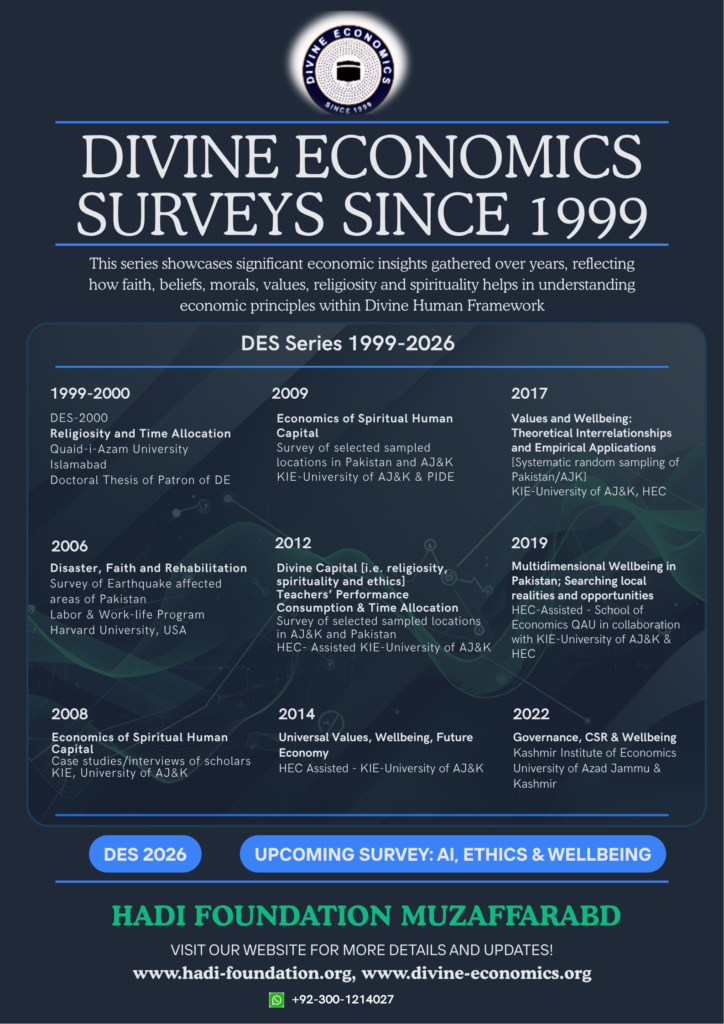
Divine Economics Surveys (DES) Series 2000-2020
The validity of faith-based economic modelling depends on reliable measurement of religiosity, morality, spirituality, and universal values. Syed Nisar Hussain Hamdani, the founder of Divine Economics, made a pioneering contribution by developing religiosity scales to quantify the multidimensional nature of human religious and socio-economic behaviour for economic analysis. His work has gained academic recognition, and the Higher Education Commission national curriculum in economics includes courses such as Divine Economics and Ethics, Economy & Universal Values, partly based on his research. The Divine Economics Survey (DES) series provides the empirical foundation of the Divine Economics framework and supports the advancement of this emerging field of economics.
Our Collaborators
The development of the Divine Economics Framework and the Divine Economics Survey (DES) series has been supported through collaborations with several academic institutions, financial organizations, research groups, and social sector partners. These partnerships have contributed to survey development, research dissemination, and the organization of 3 international conferences on Divine Economics.
Academic and Research Institutions
Financial and Institutional Sponsors
Education and Community Institutions
The conceptual development of the Divine Economics framework and the implementation of the DES surveys have been supported by the following academic institutions:
School of Economics, Quaid-i-Azam University
- Higher Education Commission
Applied Economics Research Centre, University of Karachi
University of Azad Jammu and Kashmir
These institutions have contributed to research collaboration, academic discussions, and survey-based research related to Divine Economics.
Several financial institutions, private organizations, and development partners have supported conferences and outreach activities related to Divine Economics, including the International Conferences on Divine Economics (2013, 2020, and 2023). Key supporters include:
State Bank of Pakistan
Bank Islami Pakistan
Meezan Bank
Habib Bank Limited
Bank of Azad Jammu and Kashmir
Pakistan Peace Collective
Paigham-e-Pakistan
Moon Creations
MTBC Bagh AJK
Jammu and Kashmir Liberation Cell
AJK Small Industries Corporation
The Global Group of Companies Pakistan
Suzuki Motor Corporation
Toyota Motor Corporation
ESTATE 313
Foundation for Research and Policy Development
Several educational institutions and community organisations have also supported outreach and engagement activities related to Divine Economics research:
- Azad Jammu and Kashmir Medical College
The Burq School
The Scholars College
Paramount School
SAPAK
Research & Publications
For publishing your research in multidisciplinary Islamic Social Sciences, Contanct Us
Journal of Divine Economics is a multi-disciplinary journal being published to promote contextual thinking in economics and revisiting the economic models in the emerging contexts. The Journal is now accepting submissions for our forthcoming issues. We welcome both simple ideas as well as most rigorous, analytical papers. Being an interdisciplinary journal, we welcome interfaith economics. The Journal accepts papers not only about economic issues but also about noneconomic issues having some economic relevance. We also publish informative pieces based on personal experiences of life relating to the effects of faith, values, and spirituality on economic behaviors and vice versa for provoking further thoughts and debates. You can submit even incomplete papers. Subject to availability at that time, our experts can act as co-authors or voluntary mentors. Once your paper goes through peer review process and you incorporate comments of reviewers, your paper will be published in the Journal as full paper.
Abstracts should be between 200–250 words, providing a concise overview of the main argument, methodology, and key findings of the paper. Full papers ranging from 3,000 to 7,000 words are preferred, as they allow for a comprehensive discussion of the research topic. All references, endnotes, and footnotes must be formatted according to the APA style, ensuring consistency and academic credibility.
Researchers, scholars, and practitioners are encouraged to submit their abstract(s) or even an initial draft of their paper for consideration. Early-stage submissions are welcomed as part of our effort to support emerging ideas and develop them through constructive feedback. If you are interested in contributing to the journal, kindly send your work to divineconomics@gmail.com. We look forward to reviewing your submissions and engaging with your scholarly contributions.

Online submission is now open, providing authors with an easy and accessible way to share their research work with the Journal. Whether you are submitting an abstract, an initial draft, or a completed paper, the online system ensures a smooth and efficient process. Once your submission is received, it will be logged into our system and forwarded to the relevant reviewers for evaluation.
Throughout the review and editorial process, you will receive timely email notifications regarding the progress and status of your paper. These updates may include confirmation of submission, reviewer comments, requests for revisions, or the final decision regarding publication. Our goal is to maintain clear and transparent communication so that authors remain fully informed at every stage.

Peer-Review Process
1. All are reviewed by our editorial team for checking appropriateness and alignment of the
work with the vision and goals of the Journal.
2. The full scientific papers are sent to experts for blind peer review.
3. The incomplete submissions are sent to experts for determining their potential and allotment
of a mentor is made on the basis of the experts’ reports.
4. If an article is not accepted, it is returned to authors who may re-submit after revisions where
applicable.
5. Editorial Board reserves the right to not publish any article without assigning any reason.
6. The views and opinions expressed in these articles are those of the authors and do not
necessarily reflect our opinion.

Research & Opportunities
Explore job openings, scholarships, research grants, and collaboration opportunities in key areas of Divine Economics.